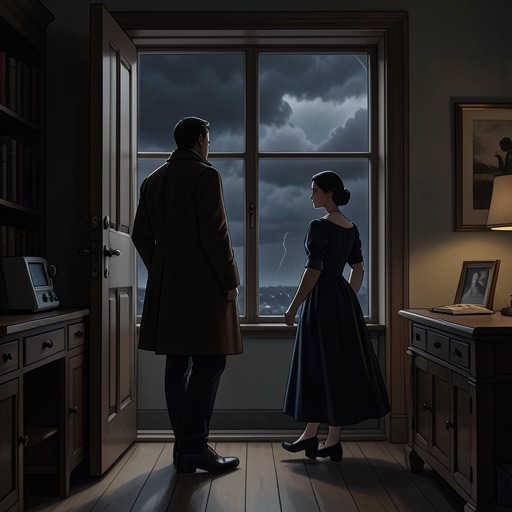
Hutch's Coma and Death
Rosemary's BabyEdward Hutchins’s sudden coma and death turn a missed appointment into a lasting warning for Rosemary Woodhouse. His unexplained collapse removes a trusted source of caution just as the dangers surrounding her pregnancy and The Bramford are becoming harder to ignore. Before he dies, Hutch leaves Rosemary a book about witchcraft and a cryptic instruction that its name is an anagram; after his death, she comes to connect his fate with the sinister forces she believes are at work in the building.
The Missed Appointment and Sudden Coma
Rosemary is waiting for Hutch at an appointment scheduled for eleven o’clock. When he has not arrived by eleven-forty, she goes into the building where she is waiting and finds a phone booth in a basement lounge. She calls the apartment’s answering service first; there is no message for her, and Guy Woodhouse has only a message from Rudy Horn. With another dime, she calls Hutch’s number directly, hoping his service will explain his absence. Instead, a woman answers in a worried voice and identifies herself as Grace Cardiff, a friend of his.
Cardiff tells Rosemary that Hutch was taken ill the previous night, or early that morning. He is in a deep coma at St. Vincent’s Hospital, and the doctors have not determined its cause. The abruptness alarms Rosemary: she spoke with Hutch at about ten-thirty the night before, and he had sounded fine. Cardiff had spoken with him not much later and found him well too. Hutch’s cleaning woman discovered him unconscious on the bedroom floor the next morning. The contrast between those ordinary conversations and his unexplained collapse leaves the illness without a clear warning or explanation.
Death and the Message
Hutch remains comatose for months. On Friday, June 3, he dies in his bed at St. Vincent’s Hospital. Rosemary learns the news the next morning. His son-in-law, Axel Allert, tells her that a memorial service will be held on Tuesday at eleven at the Ethical Culture Center on West Sixty-fourth Street.
Rosemary weeps both for Hutch and from guilt. In the preceding months she had almost forgotten him; though Cardiff had called and Rosemary had spoken with Doris Allert, she had not visited. She had seen little point in going while he remained unconscious, and, after recovering her own health, she avoided being near someone sick, fearing that the proximity might somehow endanger her or the baby. The loss therefore carries a private self-reproach alongside grief. Guy, too, reacts more deeply than Rosemary expects: he turns bloodless gray and withdraws into silence for several hours.
Cardiff brings Rosemary a book Hutch had strongly wanted her to receive. During a brief interval of consciousness near the end, he had told a nurse to make sure Cardiff gave it to Rosemary. He was reading it on the night he was stricken, and he repeated the instruction two or three times, asking the nurse to promise not to forget. His other message was that the name was an anagram. Cardiff cautions that he had been delirious, so the details are uncertain. He first seemed to think it was the morning after his coma began and spoke of needing to meet Rosemary at eleven; then, apparently realizing what had happened, he returned to the instruction about the book. It is an English book about witchcraft. His final insistence turns a private reading matter into a clue, although the message does not itself explain the cause of his collapse.
The Bramford as a Pattern of Warning
Hutch’s illness acquires a more sinister meaning against the setting he had warned Rosemary about. The Bramford is an old, imposing building divided into high-ceilinged apartments, and Rosemary and Guy had been on its waiting list before they gave up and signed a lease elsewhere. Their eventual arrival there places Hutch’s warnings within an apparently ordinary domestic life that gradually grows more threatening.
Rosemary particularly remembers the building’s basement when she goes there every few days to do laundry. The service elevator is small, unmanned, and given to sudden creaks and tremors; below, whitewashed brick passageways carry distant footsteps and the thud of unseen doors. Castoff refrigerators face the walls beneath glaring caged bulbs. In this setting, she recalls that a dead baby wrapped in newspaper had been found not long before. She wonders who the child was, how it died, and whether the person who left it was caught. Rather than read the old newspaper reports Hutch had consulted, she chooses partial ignorance, fearing that learning where the body lay would make the laundry route unbearable. The memory shows how his attempt to alert her has left her uneasy even when she resists following the warning to its source.
Retrospective Meaning
Much later, while deciding to enter the neighboring apartment herself, Rosemary thinks that Hutch was frozen and killed by the same witchcraft she associates with the Bramford coven. She suspects a hidden route between the apartments, reasoning that the coven must have entered her home despite the chained door. She focuses on the linen closet and recalls that Mrs. Gardenia had supplied herbs to Minnie Castevet. The link between Hutch’s death and witchcraft is Rosemary’s interpretation, not an explanation established by the doctors or by the account of his collapse.
Rosemary finds a concealed panel behind the closet shelves. It opens into a dark second closet, where a keyhole looks into the Castevets’ apartment. She enters through the passage with a kitchen knife and finds no crib and no baby in the bedroom. The discovery confirms the existence of a secret connection and intensifies her sense of danger, but it does not prove what caused Hutch’s coma. Structurally, his story returns as a warning that Rosemary can only understand in fragments: first the missed appointment, then the unexplained illness, the insistently delivered book, and finally her own theory of witchcraft. His death is both a personal loss and one of the clues through which the domestic unease of The Bramford takes on the shape of a conspiracy.